
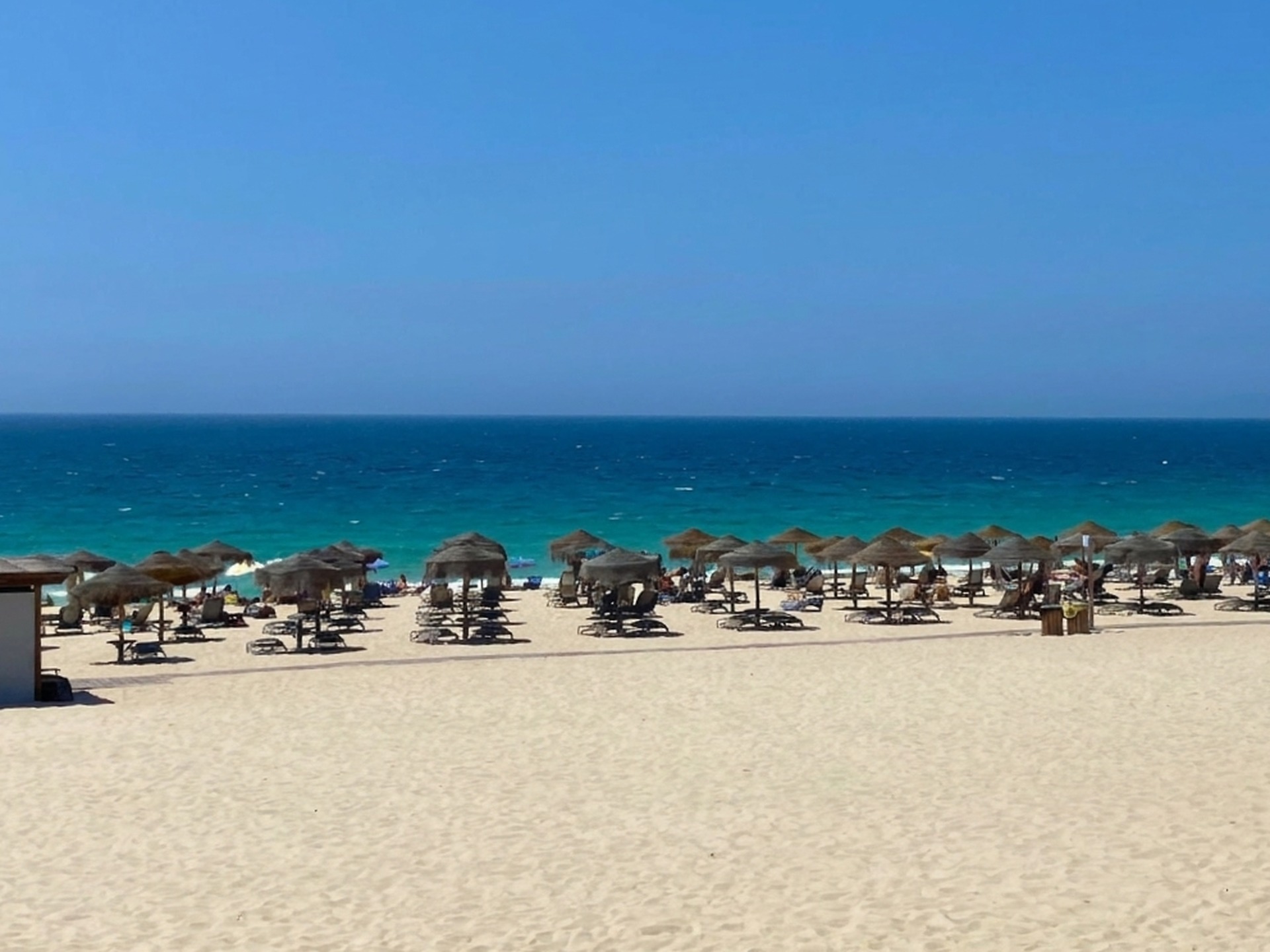
Comporta continues to attract investment, new tourism projects and both national and international buyers. At the same time, the region's environmental and landscape singularity raises an increasingly relevant question: how do you reconcile economic development, real estate appreciation and the preservation of the territory?
Few Portuguese destinations have changed international scale as much in recent years as Comporta. What was long associated with rice fields, long beaches, pine forests and small communities has also become one of the most exclusive real estate and tourism markets in Portugal. Demand grew, investment followed, and new projects keep arriving.
But there is a paradox that is hard to ignore: a significant part of Comporta's economic value comes precisely from the nature, the low density and the identity that now need to be preserved.
The question, therefore, should not simply be whether the region should keep growing. The more interesting question is another one:
How can Comporta grow without losing what made it so desirable?
A market that keeps attracting investment
The numbers help to understand the scale of the transformation. In 2026, the region continues to record new investments and relevant real estate deals.
Early in the year, a 25 million euro offer was presented for two tourism plots in the Carvalhal Tourism Development Area, another sign of investor interest in the region. In April, Quinta da Comporta, in Carvalhal, was sold for around 70 million euros to an international group. In parallel, new residential and tourism projects keep moving forward. At Pinheirinho Comporta, for example, more than 70% of the 120 plots initially released had already been sold by March, with buyers from more than ten nationalities. Interestingly, more than 75% of the acquisitions in this phase were made by Portuguese buyers. In June, a new project in the same territory was also announced, including 58 residences and a 70 room hotel, integrated in a property of approximately 400 hectares. These are movements that show a Comporta increasingly present on the premium real estate and tourism map.
Demand continues, but it is selective
The evolution of the market also deserves some nuance.
Data released in July points to positive demand in the region, although in a market characterised by limited supply, high prices and a gradual, selective recovery. In the second quarter of 2026, demand also continued to show solid absorption levels in developments below 1.5 million euros, above all among national buyers and investors.
We are therefore not looking at a conventional market. The scarcity of product, the scale of the projects, the limitations of the territory and the buyer profile make Comporta a market where each development can have a significant economic, social and environmental impact, and this is precisely where the other half of the discussion begins.
Nature is also part of the real estate value
When we talk about Comporta, nature and real estate are not necessarily opposing forces.
In reality, they are deeply connected. Barely urbanised beaches, dunes, pine forests, rice fields, proximity to the Atlantic and low density are some of the characteristics that helped create the region's identity. They are also part of the reason why buyers and investors are willing to pay high values to be there, and this creates an unusual relationship.
The more valuable the territory becomes, the greater the pressure to develop. But the greater that pressure, the more important it becomes to protect the characteristics that are at the origin of that same value.
Development can also bring benefits
It is a delicate equation. It would be equally simplistic to consider any new investment a threat to the territory. Tourism and real estate development can mean private investment, job creation, activity for local companies, better infrastructure and new economic opportunities. Recent projects also seek to incorporate concepts such as energy efficiency, use of local materials, landscape integration, soft mobility and lower environmental impact.
In the project currently under construction at Pinheirinho, for example, solutions such as solar energy, passive cooling systems and the use of locally sourced materials, including pine wood and cork, are planned.
These solutions do not automatically eliminate the impact of a development, but they show that the current discussion is no longer just about building or not building. It also involves asking how, where, how much and with what impact we build.
Preserving also means making choices
On the other side there are equally legitimate questions.
An environmentally sensitive territory has limits. More construction can mean greater pressure on natural resources, mobility, infrastructure, water and ecosystems, and the accumulation of different projects can produce a bigger impact than each development represents on its own.
There is also a social dimension. As a region becomes more exclusive and property values rise, the question arises of how that transformation affects those who already live and work in the territory. Comporta's challenge is therefore broader than preserving a particular landscape. It is also about understanding what territory we want to build for the coming decades.
Perhaps scarcity is part of the answer
There is also an interesting economic perspective. In real estate, more supply does not always mean more value for every asset. In very specific destinations, scarcity and low density can be a fundamental part of the value proposition.
Comporta will hardly compete with other destinations through quantity. It can, however, compete through the quality of the territory, architecture, privacy, nature and experience. In that sense, demanding environmental and urban planning rules do not necessarily have to be seen only as obstacles to investment.
They can also work as mechanisms that protect the region's long term value, but the balance is not automatic. Excessive restrictions can hinder necessary investment and limit economic development, while excessive development can strip the territory of its character.
It is precisely between these two extremes that the real discussion lies.
Growing without becoming another destination
Comporta faces today a challenge that many international destinations knew before it. Success generates demand, demand attracts investment, investment generates development, and development can change what created the demand in the first place.
There is no simple answer to this cycle.
Not all investment represents a threat to nature in the same way, and including sustainability in a project's communication does not, by itself, mean its impact is irrelevant.
Each project should be analysed in its context, considering environmental impact, urban planning framework, economic benefits, use of resources and integration in the territory.
For buyers and investors, this question may also become increasingly important, because the value of a property in Comporta in ten or twenty years will not depend only on the quality of the house.
It will also depend on the quality of the territory around it, a balance that may define the future of Comporta.
Perhaps Comporta's real opportunity is not in choosing between investment and preservation, but in managing to reconcile them.
Developing economically viable projects without trivialising the destination, attracting investment without compromising natural resources, creating new opportunities while keeping what differentiates the region, is a difficult balance and will probably never be consensual.
But the discussion is necessary.
At SCI Properties, we believe that analysing a territory means looking beyond the price per square metre or the expected appreciation.
It means understanding what creates value today and, above all, what may preserve it tomorrow.
In the case of Comporta, that reflection becomes particularly relevant.
Because perhaps the region's greatest asset is not what can still be built, but what we manage to preserve while we build.
Sources
- Idealista/news. (2026). Comporta attracts buyers and consolidates itself as a premium market. 30 July 2026.
- Idealista/news. (2026). Comporta welcomes 58 new residences and a hotel. 17 June 2026.
- Idealista/news. (2026). Pinheirinho: villas, apartments and hotels rising in Comporta. 25 March 2026.
- Idealista/news. (2026). Quinta da Comporta luxury resort sold for 70 million euros. 19 April 2026.
- Idealista/news. (2026). Comporta/Carvalhal: 25 million offer for two tourism plots. 27 January 2026.
Share this article on your social networks